
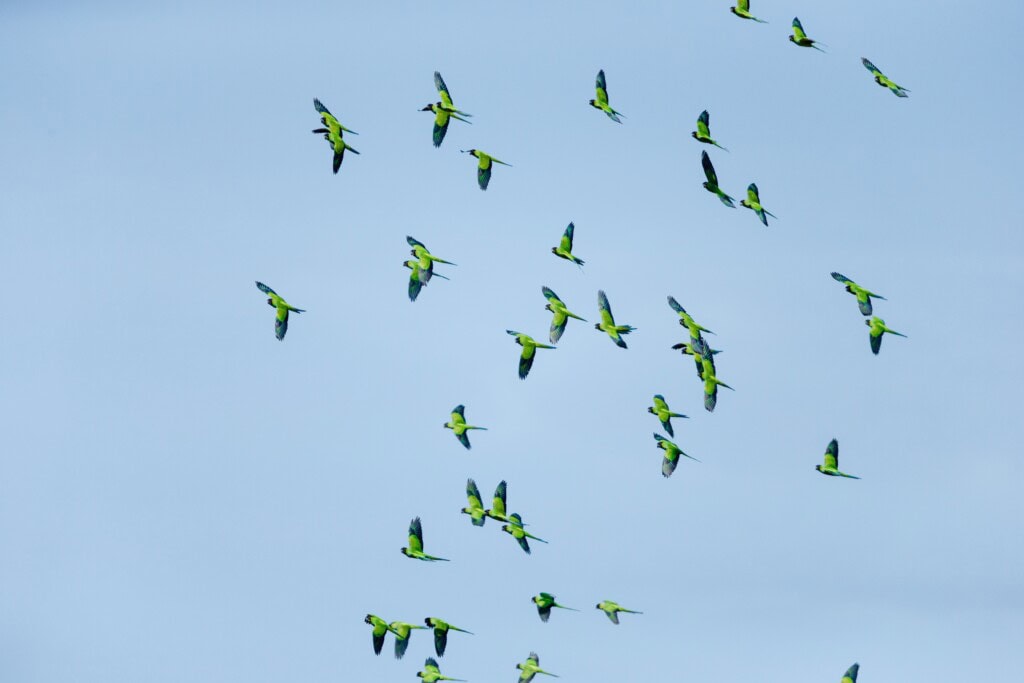

You’re sipping your coffee on the patio, still half-asleep, when it happens: a burst of shrieking, chattering, unmistakably tropical noise rips through the quiet neighborhood. You look up expecting a car alarm or a kid with a whistle — and instead you see a ragged emerald-green flock, twenty or thirty birds strong, streaking across the sky like they’ve got somewhere very important to be. Your first thought is usually some version of “wait, are those… parrots?”
They are. And if you’re staying with us in Orange County or the greater Los Angeles area, there’s a good chance you’ll hear them before your trip is over — often before you even see the ocean, Disneyland fireworks, or anything else on your SoCal bucket list. It’s one of those wonderfully weird local secrets we love pointing our Stay Hello Sunshine guests toward: the wild, loud, brilliantly colored parrots that call Southern California home.
The SoCal Parrot Secret — What Are These Birds?
Here’s the part that surprises almost everyone: these parrots aren’t native to California, and they aren’t zoo escapees or Disneyland props. They’re wild-caught birds — or descendants of wild-caught birds — smuggled or legally imported from Mexico during the exotic pet trade boom of the 1960s through ’80s, then escaped or released into Southern California’s neighborhoods. Longtime Pasadena residents still swap stories about a 1959 pet-shop fire that supposedly set flocks free, though ornithologists say the real story is likely a mix of accidental escapes, deliberate releases, and smuggling operations dumped before authorities could catch up, according to the Los Angeles Times.
Red-crowned Parrots have been documented in urban Orange County since at least the early 1970s, according to the California Parrot Project, and their numbers have only grown since. Rather than being labeled invasive, these flocks are officially considered naturalized by both California and U.S. wildlife agencies — a distinction that matters. Unlike invasive species that muscle out native wildlife, SoCal’s parrots have carved out a niche that barely overlaps with local birds. They thrive almost entirely on non-native ornamental trees — loquat, fig, silk floss, coral, and eucalyptus — the same imported landscaping that gives Southern California its signature look.
Which Parrots Will You See?
Southern California is home to more than a dozen naturalized parrot and parakeet species, but a handful show up again and again in Orange County and LA. Here’s your quick field guide:
Red-crowned Parrot — The most commonly spotted parrot in both Orange County and the San Gabriel Valley. Stocky and mostly green with a splash of red across the forehead and crown, this bird travels in loud, chattering flocks and is often the noisiest thing in the neighborhood at dawn and dusk.
Lilac-crowned Parrot — A close cousin of the Red-crowned, with a maroon forehead fading into a soft lilac-blue crown. Common throughout Orange County, and frequently seen — and even interbreeding — with Red-crowned Parrots.
Mitred Parakeet — Slimmer and more slender-tailed than the Amazon parrots, mostly green with patchy red markings around the face. Common in Orange County and well documented in Long Beach, where flocks glow golden at sunset.
Red-masked Parakeet — Similar in size to the Mitred Parakeet but with a bolder, fuller red hood over the head and face. Found alongside Red-crowned Parrots in Pasadena and San Gabriel Valley roosts.
Yellow-headed Amazon — A showstopper: a solid green body topped with a strikingly bright yellow head. Rarer than the Red-crowned, but part of the mixed flocks moving through the San Gabriel Valley.
ID tip: don’t rely on your eyes first. Parrots are gloriously loud, and you’ll usually hear the raucous squawking of an incoming flock well before you spot it overhead.
Where to Spot Them — A Local Parrot Guide
If you want to actually see a flock during your stay, location and timing both matter.
Orange County
Older OC neighborhoods with mature, mixed tree plantings are the sweet spot — think established residential streets in Fullerton, Santa Ana, Orange, and La Palma, where decades-old fruit and ornamental trees give the birds plenty to eat and nest in. Irvine Regional Park is a well-known local birding spot where Red-crowned Parrots regularly loop through the park’s oak and eucalyptus canopy. Down the coast, Long Beach has its own loud and lively Mitred Parakeet population, frequently photographed in late-day light.
Los Angeles
The epicenter of the whole SoCal phenomenon is arguably Pasadena and the broader San Gabriel Valley. Massive daily flocks of Red-crowned Parrots, Red-masked Parakeets, and Yellow-headed Amazons commute between feeding grounds and communal roosts in tall urban trees, with the area around the Rose Bowl a favorite gathering spot as birds settle in for the evening. Researchers with Occidental College’s Free-flying Los Angeles Parrot Project (FLAPP) study this very population, now considered one of the largest concentrations of Amazon parrots anywhere in the world — including their native range.
Best Time to Look
Think of it as golden-hour birdwatching. Parrots are most active — and loudest — during their morning fly-out to feeding grounds and their late-afternoon return to roost. Early morning and the hour or so before sunset are, hands down, your best windows to catch a flock in flight, often backlit against a classic SoCal sky.
A Conservation Story You Didn’t Expect
Here’s the twist worth telling over breakfast: the very Red-crowned and Lilac-crowned Parrots squawking through your neighborhood are endangered in their native Mexico, where habitat loss and cage-bird trapping have pushed wild populations down to just a few thousand birds. Meanwhile, Southern California’s naturalized flocks are stable or even growing — meaning our neighborhoods may have accidentally become one of the last strongholds for these species on the planet. Scientists at Occidental College are studying the DNA of local flocks to understand how they might one day support conservation efforts back in Mexico.
It’s a genuinely surprising footnote: birds that arrived here through an often-illegal pet trade may now be helping preserve their own species. If you spot a flock, enjoy the show — but please don’t feed them. Wild parrots don’t need human food, and organizations like SoCal Parrot, a nonprofit dedicated to rescuing and rehabilitating injured and orphaned wild parrots, ask that visitors observe from a respectful distance and let these birds stay wild.
How to Make the Most of Your Parrot-Spotting Morning
Ready to try your luck? A few tips from your hosts:
Listen first, look second. You’ll almost always hear a flock before you see one — that unmistakable, chaotic squawking carries for blocks.
Look up at the tall stuff. Mature palms, eucalyptus, and sycamore trees are prime real estate for feeding and roosting parrots.
Go early or go late. Dawn and the hour before sunset are peak activity times, and the light is gorgeous for photos.
Bring binoculars if you have them. Parrots often perch higher than you’d expect, and a little zoom helps you tell a Red-crowned from a Lilac-crowned.
Take a slow morning walk. If you’re staying at one of our properties in the Disneyland/Orange County area, a casual walk around the neighborhood before breakfast is often all it takes to catch a flock heading out for the day.
This is exactly the kind of moment we built Stay Hello Sunshine around — staying somewhere long enough, and paying close enough attention, to notice the things most visitors rush right past. Wild parrots are one of Southern California’s best “you had to be there” stories, and they’re happening right outside, whether or not anyone’s looking up.
Frequently Asked Questions
Are there wild parrots in Orange County?
Yes. Orange County is home to established, naturalized populations of Red-crowned Parrots, Lilac-crowned Parrots, and Mitred Parakeets. They’re most commonly spotted in older neighborhoods with mature trees, at Irvine Regional Park, and around Long Beach.
Where did the wild parrots in Los Angeles come from?
LA’s wild parrots are descendants of birds smuggled or imported from Mexico and Central America during the pet trade boom of the 1960s through 1980s that later escaped or were released. Wildlife agencies now classify them as naturalized rather than invasive, since they rely on non-native ornamental trees and don’t compete with local bird species.
Where is the best place to see wild parrots in Southern California?
Pasadena and the San Gabriel Valley are the biggest hotspots for large, loud daily flocks, especially near the Rose Bowl at dawn and dusk. In Orange County, try older residential neighborhoods, Irvine Regional Park, or Long Beach, ideally during early morning or late afternoon roosting times.
Discover SoCal’s Hidden Surprises with Stay Hello Sunshine
Wild parrots are just one of the many quirky, wonderful details that make Southern California feel different once you slow down long enough to notice them. That’s the whole idea behind staying with Stay Hello Sunshine — thoughtfully designed homes in Orange County, the Disneyland area, and beyond, made for guests who want to live like a local, even for a few days. Book your stay, take a morning walk, and keep your ears open. You might just catch SoCal’s best-kept secret flying right over your head.
